⚠ The Challenge
Social media text is messy — abbreviations, emojis, slang, misspellings, and sarcasm all challenge standard NLP models. Needed a robust pipeline for real Twitter/social media text.
💡 The Approach
Built a comprehensive pipeline training 4 ML models and 1 LSTM simultaneously. This comparison shows clients which approach actually works better for their specific text type and volume.
🔄 Step-by-Step Process
Applied full NLTK preprocessing: lowercase, remove URLs/mentions/punctuation, stop words, stemming
Used TF-IDF vectorization with 10,000 most common words as features for ML models
Trained 4 ML models: Logistic Regression, Naive Bayes, SVM, Random Forest
Built LSTM with word embeddings for deep learning comparison
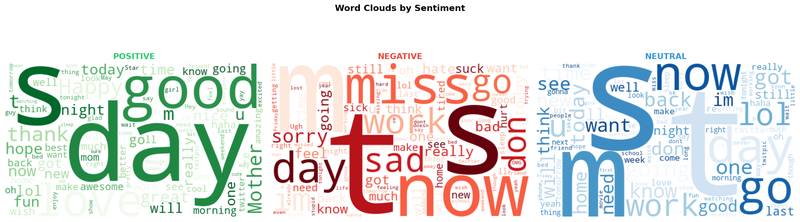
Created word cloud visualization showing most common positive vs negative terms
Built batch CSV analysis mode for processing thousands of posts at once
✓ Final Result
TF-IDF + Logistic Regression competes with LSTM on short social media text while being 100x faster to train. Word cloud visualization reveals language patterns in audience feedback.
📚 Key Lesson
For short text like tweets, traditional ML with TF-IDF often matches or beats LSTM while being far simpler and faster. Deep learning shines on longer, context-dependent text.